Mountain House Plans vs Farmhouse Plans: Which Is Right for Your Lot?
If you’re sitting on a piece of land and trying to figure out whether to build a mountain house or a farmhouse, you’re not alone. The debate over mountain house plans vs farmhouse plans is one I walk through with clients almost every week. Both styles are beautiful, functional, and timeless – but they’re designed for very different settings, lifestyles, and terrain. Choosing the wrong one for your lot can mean unnecessary site work costs, awkward proportions, or a home that just doesn’t feel right where it sits.
I’ve spent years designing both styles, and I can tell you the decision isn’t just about aesthetics. It comes down to your land, your budget, how you want to live inside the home, and what makes sense long-term. Let me break it all down so you can make a confident call.
What Defines a Mountain House Plan?
Mountain house plans are built to embrace rugged, sloping terrain. They’re designed to feel anchored into a hillside – not fighting against it. Here are the hallmarks:
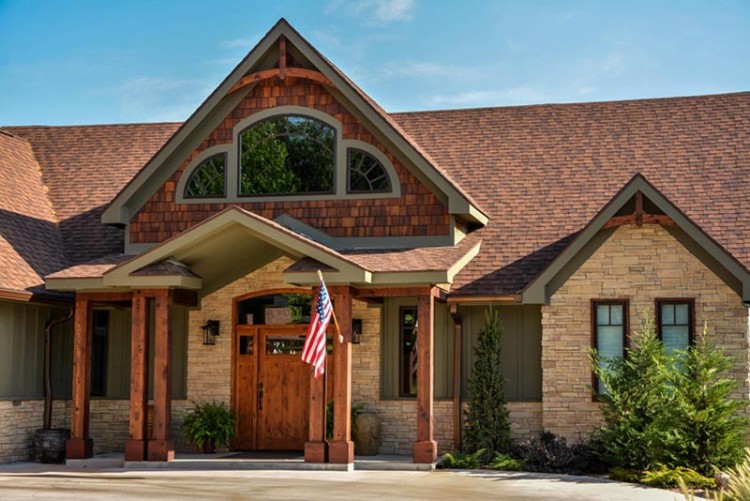
- Steep roof pitches (typically 8/12 to 12/12) – these shed snow and rain efficiently and create dramatic interior volume
- Exposed timber framing, stone, and natural materials that blend with the surrounding landscape
- Large windows and outdoor living spaces positioned to capture views – often rear-facing with expansive decks
- Walkout basements or daylight lower levels that take advantage of grade changes
- Vaulted great rooms with soaring ceilings, often open to a loft above
- Heavy use of gable and shed dormers to maximize usable space under those steep roofs
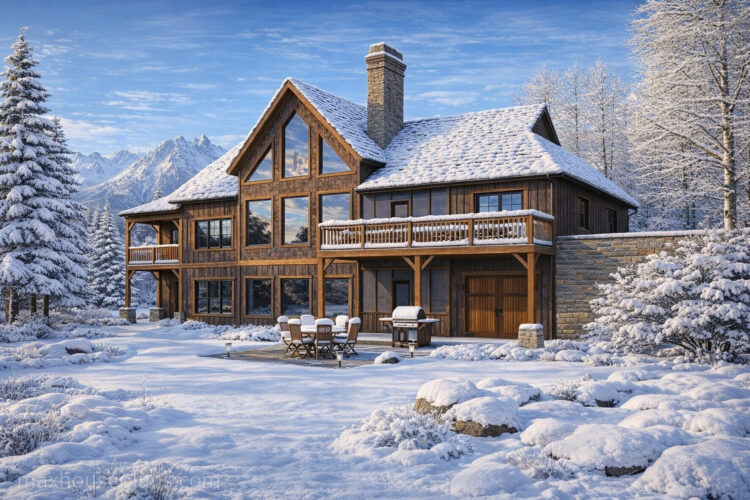
A plan like our Appalachia Mountain is a textbook example – steep rooflines, a stacked stone chimney, and a layout that was drawn specifically for a sloped lot with rear views. Every square foot earns its place.
Mountain homes tend to feel vertical. You’re stacking living spaces to work with the grade, and the interior drama comes from height – tall ceilings, open lofts, and windows that pull the landscape inside.
What Defines a Farmhouse Plan?
Farmhouse plans come from a completely different tradition. They evolved on flat, open land where the goal was practical, livable space that could grow with a family. The characteristics are distinct:
- Moderate roof pitches (typically 6/12 to 8/12) – enough for character without the structural cost of steep pitches
- Board-and-batten or lap siding with a clean, approachable exterior
- Wrap-around or deep front porches – the farmhouse signature
- Open, flowing floor plans centered around the kitchen as the heart of the home
- Single-story or story-and-a-half designs that spread horizontally
- Practical mudrooms, pantries, and utility spaces built into the plan from the start
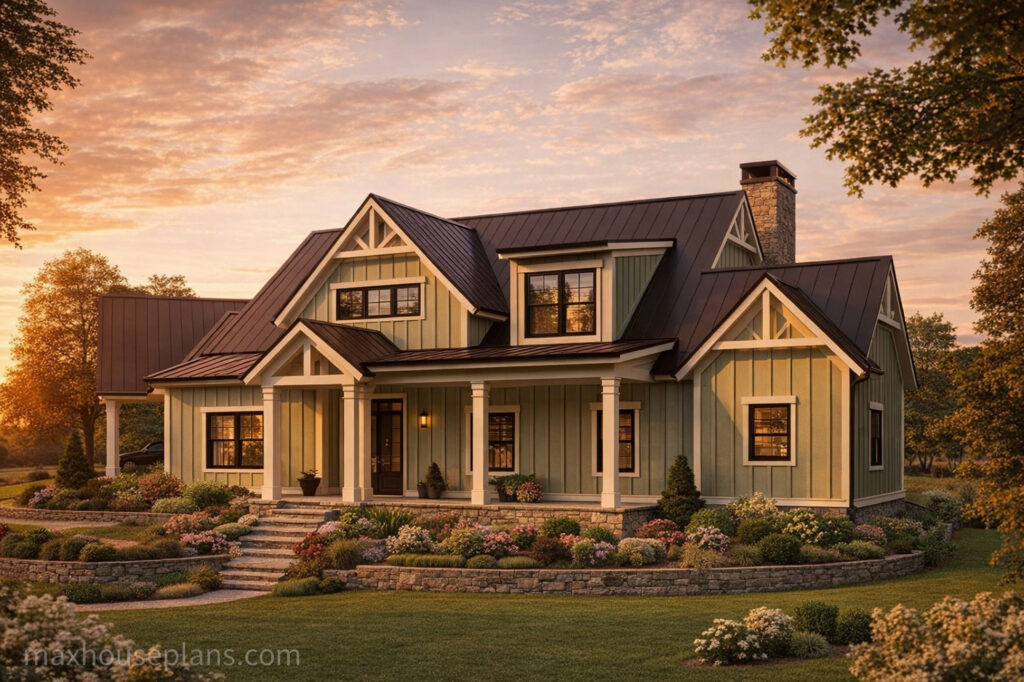
Our Carolina Farmhouse captures this perfectly – a generous wrap-around porch, an open-concept living area, and a layout that’s intuitive the moment you walk in. No wasted hallways, no dead space.
Farmhouses feel horizontal. They spread across the land rather than reaching upward, and the interior flow prioritizes everyday function over dramatic volume.
Roofline: The Most Visible Difference
The roofline is the first thing people notice, and it’s where mountain and farmhouse plans diverge most sharply.
Mountain house roofs are steep by necessity and design. A 10/12 or 12/12 pitch sheds heavy snow loads, creates attic or loft space, and gives the home that iconic alpine silhouette. You’ll often see multiple gables, shed dormers, and metal roofing. The tradeoff? Steeper pitches cost more to frame and roof – both in materials and labor.
Farmhouse roofs are moderate – typically 6/12 to 8/12. They give the home enough visual interest without the added cost of steep framing. You’ll see simple gable forms, sometimes a cross-gable for a secondary wing, and standing-seam metal is popular here too. The proportions are meant to look grounded and approachable, not towering.
Here’s a practical tip: if your lot has significant tree canopy or sits in a valley, a steep mountain roof can actually help with leaf and debris shedding. On open, flat land, that same steep roof can look oddly out of place – like a ski lodge dropped in a cornfield.
Lot Requirements: This Is Where It Really Matters
This is the part most people skip, and it’s the most important factor in the mountain house plans vs farmhouse plans decision.
Mountain House Plans and Sloping Lots
Mountain homes are engineered for grade. A lot that drops 8 to 15 feet from front to back is ideal – it gives you a walkout lower level, stacked views from multiple floors, and a natural way to tuck the foundation into the hillside. Plans like the Adirondack House Plan are designed specifically for this kind of terrain, with a lower level that opens to grade at the rear.
If you try to put a mountain house plan on flat ground, you lose the walkout advantage, the proportions can look top-heavy, and you may end up with an awkward, windowless basement that defeats the purpose of the design.
Farmhouse Plans and Flat or Rolling Lots
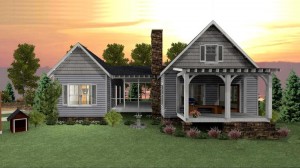
Farmhouses want room to breathe. They’re designed for flat or gently rolling terrain where the home can spread out horizontally. A wide, level building pad is ideal – especially for single-story plans with wrap-around porches like our Low Country Farmhouse.
Trying to squeeze a wide farmhouse onto a steep lot usually means expensive site work – retaining walls, fill dirt, grading – to create a flat pad. And once it’s built, that horizontal farmhouse perched on a steep hill just doesn’t look natural.
The rule of thumb: Let your land tell you what to build. Sloping lot with views? Mountain plan. Flat acreage or gentle roll? Farmhouse. Fighting the terrain always costs more and looks worse.
Interior Layout: How You Actually Live in These Homes
Beyond the exterior, the way space is organized inside these two styles is fundamentally different.
Mountain Home Interiors
Mountain plans tend to be vertical and dramatic. You’ll find:
- Vaulted great rooms with 18- to 24-foot ceilings
- Open lofts overlooking the main living area
- Stacked living – main floor living with bedrooms above or below
- Large rear windows and sliding doors oriented toward the view
- Stone fireplaces as a central design anchor
The tradeoff is that vaulted ceilings mean higher heating costs, and multi-level living means more stairs. For aging-in-place, mountain plans can be trickier unless you choose a design with a main-floor master suite.
Farmhouse Interiors
Farmhouse plans are open, practical, and family-centered. Expect:
- Open-concept kitchen, dining, and living areas
- 9- to 10-foot ceilings – comfortable, not cavernous
- Dedicated mudrooms and utility spaces near entries
- Walk-in pantries (the modern farmhouse essential)
- Main-floor master suites as the norm, not the exception
Farmhouse layouts are naturally aging-friendly. Most of your daily living stays on one level, and the practical spaces – mudroom, pantry, laundry – are right where you need them. The Forever Farmhouse is a great example of this kind of thoughtful, single-level living.
Build Cost Comparison
Clients always want to know: which one costs more to build? The honest answer is it depends on your lot and finishes, but here are the general trends:
- Foundation: Mountain plans on sloped lots often need more complex foundations (stepped footings, retaining walls), but you gain usable lower-level space in return. Farmhouse plans on flat lots use simpler slab or crawlspace foundations.
- Framing: Steep roof pitches (mountain) cost 15-25% more to frame than moderate pitches (farmhouse). Vaulted ceilings add structural complexity.
- Exterior materials: Mountain homes lean toward stone, timber, and metal – which are typically more expensive than the siding and trim packages on a farmhouse.
- Overall per-square-foot: Mountain homes generally run $10-30 more per square foot than a comparable farmhouse, driven by roof complexity, materials, and multi-level construction.
That said, a mountain home’s walkout lower level often gives you 30-50% more finished space at a fraction of above-grade construction cost. So the total cost per usable square foot can actually be competitive.
Resale Value: What the Market Says
Both styles hold strong resale value, but the market matters:
- Mountain homes perform best in resort-adjacent areas, mountain communities, and scenic regions where buyers are looking for that specific aesthetic. In the Smokies, Blue Ridge, or Rockies, a well-designed mountain home commands premium prices.
- Farmhouses have broader market appeal. The modern farmhouse look resonates with buyers in suburban, rural, and even semi-urban settings across the country. It’s arguably the most universally appealing residential style right now.
If you’re building purely as an investment, the farmhouse style gives you a wider buyer pool at resale. If you’re building in a mountain market for personal use, a mountain home will feel more authentic and likely appraise better in that context.
How to Decide: A Simple Framework
After designing hundreds of both styles, here’s how I help clients make the call:
- Start with your lot. Slope and terrain should be the first filter. Don’t fight the land.
- Consider your climate. Heavy snow regions favor steep mountain roofs. Mild climates give you more flexibility.
- Think about how you live. Want drama and views? Mountain. Want open, practical, one-level flow? Farmhouse.
- Factor in long-term needs. Planning to age in place? Farmhouse plans with main-floor masters are hard to beat.
- Check your local market. Build what fits the area – it protects your investment and looks right in the neighborhood.
And remember – these aren’t rigid categories. Some of our best-selling plans blend elements of both. A farmhouse with a steeper roof pitch. A mountain home with farmhouse-style porches. Good design is about matching the home to the land and the people who’ll live in it.
Frequently Asked Questions
Can I build a mountain house plan on flat land?
Technically yes, but the design won’t perform the way it was intended. You’ll lose the walkout lower level, the proportions may look top-heavy, and you’ll pay for foundation complexity without the payoff. If your lot is flat, a farmhouse plan will look and function better.
Are farmhouse plans cheaper to build than mountain house plans?
Generally, yes. Farmhouse plans typically cost $10-30 less per square foot due to simpler roof framing, moderate pitches, and less expensive exterior materials. However, a mountain plan with a walkout basement can deliver more total living space for the money, so compare total project cost – not just per-square-foot numbers.
Which style is better for aging in place?
Farmhouse plans are the clear winner here. Most feature main-floor master suites and single-level living as standard. Mountain plans spread living across multiple levels, which means more stairs. That said, some mountain plans include a main-floor master – just make sure to prioritize that feature if accessibility matters to you.
Do mountain house plans or farmhouse plans have better resale value?
It depends on location. Mountain homes command premium prices in scenic, resort, and mountain communities. Farmhouses have broader appeal across almost any market – suburban, rural, and small-town settings. For the widest buyer pool at resale, farmhouse style currently has the edge nationally.
Can I combine mountain and farmhouse elements in one plan?
Absolutely – and some of the best custom homes do exactly that. You might take a farmhouse’s open floor plan and wrap-around porch, then pair it with a steeper roof pitch and natural stone accents. The key is making sure the blend suits your specific lot and climate. If you’re interested, browse our full collection for plans that bridge both styles.
Ready to Find Your Plan?
Whether you’re leaning mountain, farmhouse, or something in between, the right plan starts with understanding your land and how you want to live. I’ve designed every plan in our collection to eliminate wasted space and reduce build costs – no filler square footage, no impractical layouts.
Browse our full collection of house plans and find the design that fits your lot, your budget, and your life. And if you need help deciding, reach out – I’m always happy to talk through the options.