


Guide May 6, 2026
Basement Waterproofing for Mountain and Lake Builds
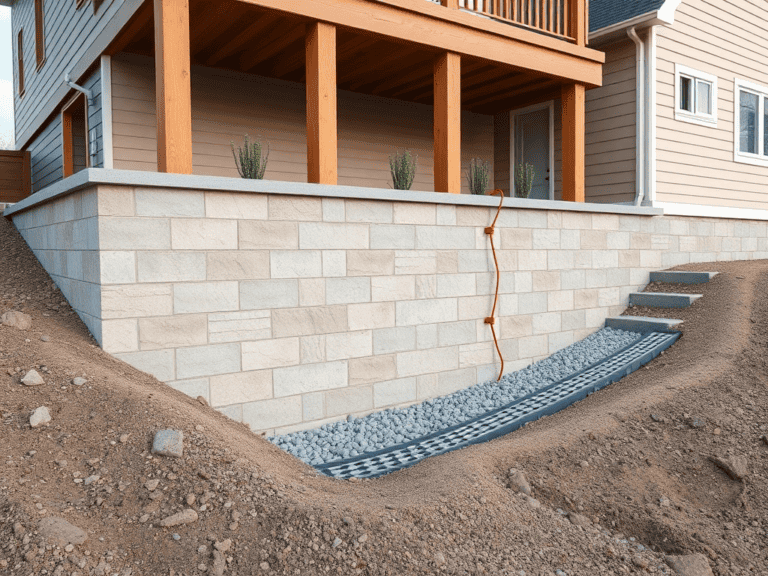
More walkout basements fail from poor waterproofing than from any other single cause. Not because waterproofing is complicated — it’s not — but because it’s easy to cut corners on something you can’t see after the foundation is backfilled. The time to ask the right questions is before the concrete is poured.
Why mountain and lake sites are harder
Three factors make below-grade construction on mountain and lake lots more demanding than suburban basements:
- Seasonal water movement. Mountain sites often have spring snowmelt that saturates the soil for weeks. Lake lots have high water tables that fluctuate with precipitation. Both create sustained hydrostatic pressure against foundation walls.
- Slope drainage concentration. On a sloped lot, the uphill side collects runoff from a large area and concentrates it against the uphill foundation wall. A flat suburban lot doesn’t have this problem.
- Remote site challenges. A wet basement in a lake cabin that’s empty for months is a serious mold and structural problem by the time you discover it. Reliability matters more than it does in a primary residence.
The four components of a proper system
1. Exterior waterproofing membrane
Applied to the outside of the foundation wall before backfill. Options include sheet-applied membranes (the most reliable), spray-applied elastomeric coatings, and dimple mat drainage boards. Sheet membranes are the highest standard — they’re bonded continuously and don’t depend on consistent application thickness.
Interior waterproofing paint or sealants are not a substitute. They handle minor condensation and small seepage, not hydrostatic pressure.
2. Drainage board (dimple mat)
A plastic drainage board installed against the exterior membrane creates an air gap that directs water down and away from the wall rather than letting it pool against the foundation. Costs $0.50–$1.50 per square foot of wall area — inexpensive protection against a serious problem.
3. Drain tile (footing drain)
Perforated pipe installed at the base of the footing, sloped to drain to daylight or to a sump pit. On a sloped lot, gravity drain to daylight is preferable — no pump to fail, no power outage risk. Install on the uphill side as a minimum; around the full perimeter if the water table is high or the site has heavy spring moisture.
4. Sump pit and pump (when gravity drain isn’t possible)
When the grade doesn’t allow gravity drainage, a sump pit with a submersible pump handles water that collects in the drain tile system. On a lake or mountain cabin, use a quality pump with battery backup. A failed sump pump during a week-long rain while the cabin is empty is a worst-case scenario — the backup is cheap insurance.
What to ask your contractor
- What exterior waterproofing product are you specifying? (Ask for the brand and technical sheet.)
- Are you installing drain tile at the footing or only at mid-wall? (Footing level is standard.)
- Does the drain tile have a gravity outlet or does it depend on a sump pump?
- What’s the drainage plan for the uphill side of the foundation specifically?
- Is there a drainage board installed between the waterproofing membrane and the backfill?
A contractor who can’t answer these questions clearly is telling you something about their waterproofing approach.
Grade management around the foundation
The finished grade should slope away from the foundation in all directions at a minimum of 6 inches over the first 10 feet. This is basic but frequently ignored — especially on sloped lots where grading gets complicated by terrain.
Window wells on the uphill side of a walkout need their own drainage. A window well that collects water and has no drain route is a direct path into the basement. Window well drains should connect to the footing drain system or to daylight.
Interior drainage as a backup
Even with a good exterior system, an interior drainage channel along the perimeter of the lower-level slab adds a layer of protection. In mountain and lake environments with seasonal water pressure, interior drainage catches any moisture that gets through the exterior system and routes it to the sump before it reaches the floor. Cost is $30–$60 per linear foot installed.
FAQ
How long does exterior waterproofing last?
A properly installed sheet membrane should last 20–30 years. Spray-applied coatings vary by product — some are rated for 10 years, others for 20+. The limiting factor is usually not the membrane itself but the condition of the drainage system — if the drain tile clogs after 15 years and the membrane is holding 6 inches of hydrostatic pressure, you’ll find out where the weak points are.
Can I waterproof a basement from the inside after the fact?
Interior waterproofing systems (crystalline treatments, drainage channels, sump pumps) can manage water after it enters the wall. They can’t prevent hydrostatic pressure from building against the foundation. They’re a legitimate approach for an existing basement with occasional seepage, but they’re not a substitute for proper exterior waterproofing on a new build.
What does radon have to do with basement waterproofing?
Radon enters through the same cracks and penetrations that water does. A properly sealed foundation reduces both water and radon entry. On a new build in a radon-prone area (much of the mountain South and Appalachia), install a passive radon mitigation system during construction — a perforated pipe under the slab connecting to a vent through the roof. Costs $300–$500 during construction vs. $800–$2,500 as a retrofit.
Waterproofing checklist for new construction
- ☐ Exterior waterproofing membrane specified (sheet-applied preferred)
- ☐ Drainage board installed against membrane before backfill
- ☐ Drain tile at footing level, full perimeter or uphill side minimum
- ☐ Gravity drain to daylight if grade allows; sump pit with backup pump if not
- ☐ Finished grade slopes away from foundation min. 6 in. over 10 ft.
- ☐ Window well drains connected to drainage system
- ☐ Passive radon pipe installed if in radon-prone zone
Related Reading
Looking for the plan that fits your land?
Browse the full catalog or call Max Sr. directly. We've been doing this since 1990 — usually it's a 10-minute conversation.