


Guide May 6, 2026
Sloped-Lot Foundations Explained: Crawl, Daylight, Walkout, and Stepped
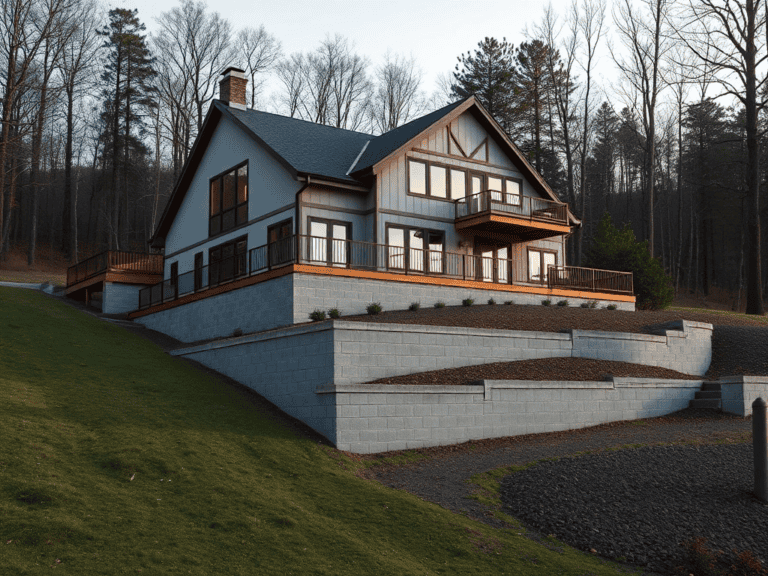
A sloped lot isn’t a problem to solve. It’s a site condition to work with. The four foundation types that handle slope each have a different cost profile, a different relationship to the landscape, and a different effect on how the house lives. Picking the wrong one costs you either money or livability — often both.
The four options
1. Crawl space on a sloped lot
A crawl space foundation uses perimeter stem walls of varying heights to keep the floor level while the grade changes underneath. On a gentle slope (less than 4 feet of fall across the footprint), a crawl space is often the most economical option — less excavation than a basement, simpler formwork than a stepped foundation.
The downside: tall stem walls on the downhill side can make the house feel elevated above the landscape. A house sitting 5 feet above grade on the downhill side has no relationship to the ground. It also concentrates moisture problems — a crawl space with a 6-foot air gap on one side and 12 inches on the other needs a vapor barrier, cross-ventilation, and a maintenance plan.
When it works: gentle slopes (2–4 feet of fall), small footprints, when the finished floor height above grade is acceptable on the downhill side.
2. Daylight basement
A daylight basement is a full-height below-grade space where the downhill wall is partly above grade — enough for windows at or near ground level, but not a door. You get natural light in the lower level but no direct walk-out access.
Daylight basements are useful for mechanical rooms, storage, and utility space where you want light but don’t need access to the outdoors. They’re less useful as living space because the partial grade relationship makes the lower level feel half-buried.
When it works: moderate slopes (4–7 feet of fall), when the lower level is primarily utility or unfinished storage, when a full walkout isn’t justified by the program.
3. Walkout basement
A walkout basement costs is a full-height lower level where the downhill wall is entirely above grade — door, full-height windows, direct outdoor access at grade. On a lot with 8 or more feet of fall, the walkout is usually the most cost-effective way to add real living space.
The walkout is the right choice when you want the lower level to be a real floor of the house: bedroom suite, family room, home office, bunk room, or a combination. It’s also the right choice when the lot’s slope offers a lower-level view — on a lake lot with a walkout basement, the lower porch is often better lake access than the main-floor deck above it.
When it works: 8+ feet of fall, when the lower level is planned as living space, when the downhill side has a view worth accessing.
4. Stepped foundation
A stepped foundation divides the footprint into multiple levels, each with its own foundation at a different elevation. Instead of one continuous foundation depth, you step the foundation down the slope in increments. The floor plan above can be flat (with interior level changes handled by stairs), or the living levels can step with the foundation.
Stepped foundations work on sites where the slope is too gradual for a walkout but too steep for a single-level crawl space or basement. They’re common on split-level plans and on lots with a consistent moderate grade (5–9 feet of fall).
When it works: moderate to steep slopes, complex topography that makes a single foundation depth impractical, multi-level plan designs.
Matching foundation to fall
- 0–3 feet of fall: Standard slab or crawl space, minimal additional cost
- 3–5 feet of fall: Tall crawl space or partial basement, modest upcharge
- 5–8 feet of fall: Daylight basement or stepped foundation territory
- 8–12 feet of fall: Walkout basement is the natural fit — best cost per livable square foot
- 12+ feet of fall: Walkout with drive-under garage, multi-level stepped design, or full basement with daylight on upper portion
The cost driver most people miss: retaining walls
Whatever foundation type you choose on a sloped lot, grade management around the perimeter affects cost significantly. A walkout basement on a lot with 10 feet of fall may require a retaining wall on the uphill side to manage the grade transition from the foundation to the natural terrain. Retaining walls run $30–$75 per square foot of retained face, depending on height and material.
Gravity block walls under 4 feet can be DIY. Engineered walls over 4 feet require a structural design and typically a permit. On a lot with significant grade, retaining wall cost can equal or exceed foundation cost — budget for it before you commit to a plan.
What your builder needs to know before foundation decisions
- A reading a topographic survey of the lot at 2-foot contour intervals
- A soil report (boring or test pits) to identify rock, water table, and bearing capacity
- The proposed building envelope overlaid on the topo
- The finished floor elevation of the main level and any lower levels
Don’t commit to a plan’s foundation type until you have all four. The lot survey is the most important document — it tells you whether the grade change you’re designing around is real.
FAQ
Can I change a plan’s foundation type?
Yes, with a modification. Converting a slab plan to a walkout is a significant modification — the structural framing, stair placement, and rear elevation all change. Converting a crawl space to a partial basement is simpler. Get a modification quote before deciding whether to modify or find a plan already designed for your foundation type.
How does a sloped lot affect septic system placement?
Significantly. Conventional septic systems need level or gently sloping field areas. On a steeply sloped lot, you may need an engineered mound system, a low-pressure pipe system, or a pump-up system — all of which cost more and have specific siting requirements. Get a perc test and septic feasibility assessment before finalizing the building envelope on a sloped lot.
Is a walkout basement always the cheapest way to add square footage?
On a site with adequate natural slope, yes — finished walkout space runs $60–$100/sq ft vs. $150–$250/sq ft above grade. But only on a site with the right conditions. Forcing a walkout onto a flat or gently sloped lot requires expensive cut-and-fill, retaining walls, and drainage engineering that erases the cost advantage.
Foundation decision checklist
- ☐ Measured fall across the proposed footprint from my topographic survey
- ☐ Identified rock, water table, and soil bearing capacity from site investigation
- ☐ Matched foundation type to actual fall measurement (see table above)
- ☐ Budgeted for retaining walls on the uphill side if needed
- ☐ Confirmed septic feasibility with county health department
- ☐ Verified the plan’s foundation type matches my site conditions
n
Related Reading
Looking for the plan that fits your land?
Browse the full catalog or call Max Sr. directly. We've been doing this since 1990 — usually it's a 10-minute conversation.