


Guide May 6, 2026
Screened Porches Sized Like Real Rooms (Not an Afterthought)
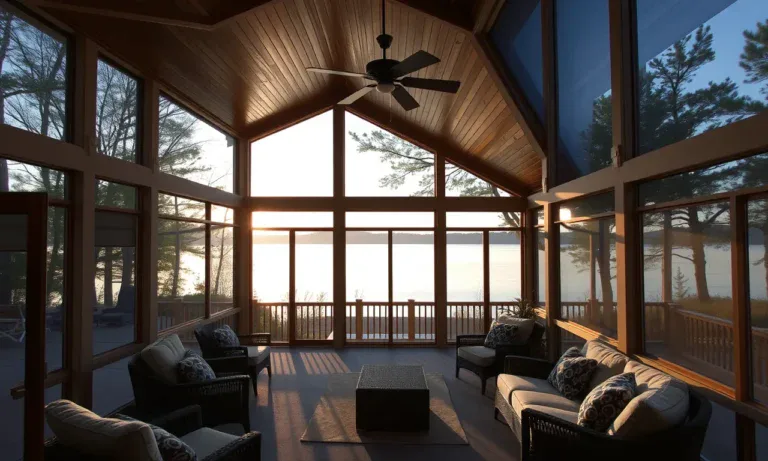
I’ve seen more screened porches that don’t work than ones that do. Not because they were built wrong — because they were sized wrong before the first nail went in. A 6×8 screened porch is a screen door vestibule, not a room. A 10×12 porch can work for two people. A 14×20 porch is where lake living actually happens.
If you’re evaluating lake house plans with porch, here’s how to read screened porch dimensions before you fall in love with a floor plan.
The minimum that actually works
Eight feet deep. That’s the floor for a screened porch that functions as a real room. Below 8 feet, you can’t fit a table and chairs on one side, a sitting area on the other, and still have a traffic lane. You end up with furniture pushed against the screens and people walking through the seating every time someone comes outside.
Eight feet gets you a functional single-purpose porch — dining or sitting, not both. Ten feet lets you do one thing well with real breathing room. Twelve feet is where the porch starts to feel like a room of the house rather than a transition space.
For a lake house where the screened porch is the primary living space three seasons out of four, 14 feet deep is the target. A 14×20 screened porch — 280 square feet — is a proper room that handles a dining table, a seating group, and still has space to move.
Width matters more than depth for lakes
On a lake lot, the screened porch faces the water. Width determines how much of that view you capture and how many people can sit in it simultaneously. A 12-foot-wide porch with a centered lake view feels narrow. A 20-foot-wide porch starts to frame the scene.
The best lake house porches run the full width of the great room behind them — or close to it. When the porch matches the room’s width, you get a sense of continuity between indoor and outdoor space. The porch doesn’t feel like an add-on; it feels like the room opened its back wall.
For a side-access porch (common on narrow lots), width becomes depth and vice versa — the same minimums apply, just rotated.
Screened vs. open: the real question for Southern lake lots
In the Southeast and mid-Atlantic, screened is almost always better than open for a main lake porch. The combination of no-see-ums, mosquitoes, afternoon thunderstorms, and summer heat makes an open porch a June-through-August gamble. A screened porch is a three-season room.
The cost difference between a screened porch and an open covered porch is modest — screen systems run $15–$30 per linear foot of opening, plus frames. On a 20-foot-wide porch, you’re adding $1,500–$3,000 to the project cost. For the usability you gain, it’s one of the highest-return items in the house.
In higher elevations (above 3,500 feet) and in the northern lake states, insect pressure drops enough that open porches compete. But even there, afternoon rain coverage is worth having.
The connection to the great room
Porch size matters less than porch connection. A 14-foot-deep screened porch that connects to the great room through a 6-foot door opening is still a separate room. A 12-foot-deep porch that connects through a full wall of sliding glass or accordion doors feels like one continuous space.
When evaluating floor plans, look at the opening width between porch and great room. This detail is usually visible on the floor plan as the door/opening symbol on the rear wall:
- Single door (3 ft): functional access, minimal flow
- Sliding glass door pair (6–8 ft): opens the connection meaningfully
- Three-panel or accordion system (10–14 ft): porch and room read as one space when open
- Full wall of sliders or folding glass (16+ ft): true indoor-outdoor continuity
The last two options add cost but transform how the house lives. On a lake lot where you paid a premium for the water view, this is where to put money.
Ceiling height and roof pitch on the porch
A screened porch with an 8-foot flat ceiling feels like a covered parking space. Porch ceilings should be at least 9 feet, and 10–11 feet is better on a lake house where the scale of the view calls for more vertical space.
Exposed rafter or beam ceilings read better than flat drywall ceilings on a porch. They add visual interest and reinforce the outdoor character. If the plan shows a flat soffit ceiling on the porch, ask your builder what it would take to expose the structure.
Roof pitch matters for rain protection. A shallow pitch (3:12 or less) on a deep porch lets driving rain reach the screen line on the rear wall. A steeper pitch (6:12 or higher) with deep overhangs keeps more rain out and makes the porch usable in all but the worst storms.
FAQ
What’s the minimum screened porch size for a dining table?
A 36×72-inch dining table needs about 10 feet of depth and 14 feet of width to seat six with chair pull-out room on all sides. That’s a 10×14 porch just for dining. If you want a sitting area too, add at least another 10 feet of depth — so a 10×24 or 12×20 porch for a dual-purpose space.
Can I convert an open porch to screened after the fact?
Yes, if the structural posts and roof are already there. Retrofit screen systems — aluminum frames with fiberglass mesh — can be installed between existing posts. The main constraint is post spacing: openings over 10 feet may need an intermediate post or a heavy-duty screen frame system. Cost runs $80–$150 per linear foot of screening for a retrofit system installed by a contractor.
How do I know if a floor plan’s porch will actually have the lake view?
Check the rear elevation. If the porch appears on the rear elevation as a covered structure facing what will be the water side, it has the view. Then verify by running the six-step orientation check from our lake house orientation guide — the porch should be on the same side as the great room and primary bedroom windows.
Does porch square footage count in the listed square footage?
Usually not. Most plan listings show conditioned living area only. A 1,800-square-foot plan with a 280-square-foot screened porch gives you 2,080 square feet of usable space, but the plan will list 1,800. Always check whether porch, garage, and basement are included or excluded in the listed square footage.
Porch sizing checklist
- ☐ Porch depth is at least 10 feet (12+ preferred for a lake house)
- ☐ Porch width matches or approaches the great room width behind it
- ☐ Opening between porch and great room is at least 8 feet wide
- ☐ Ceiling height is at least 9 feet (10–11 preferred)
- ☐ Roof pitch is at least 4:12 for weather protection
- ☐ Porch faces the water side (verified on rear elevation)
- ☐ Screened vs. open decided based on regional insect/rain pressure
Related Reading
Looking for the plan that fits your land?
Browse the full catalog or call Max Sr. directly. We've been doing this since 1990 — usually it's a 10-minute conversation.