


Guide May 6, 2026
Mountain House vs. Farmhouse — Which Fits Your Land?
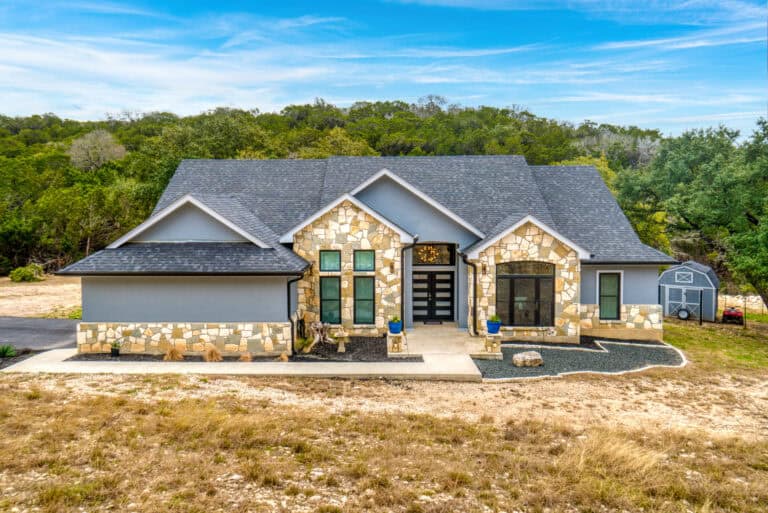
Mountain house and modern vs. traditional farmhouse are different design responses to different land problems. Pick the wrong one and you’re fighting the site for every cost dollar.
They Solve Different Site Problems
Mountain houses are drawn for topography. The defining challenge is grade — a lot that drops 20, 30, or 40 feet from road to view. Mountain designs use that grade: walkout lower levels, multi-tier decks, rear-facing living areas, a roof pitch that reads well from below.
Farmhouses are drawn for flat, open land. The historical farmhouse sat on cleared acreage where the challenge wasn’t grade — it was exposure. Deep wraparound porches handle that. Wide-open floor plans work because you’re not stacking program to manage a slope.
What a Mountain House Does for a Sloped Lot
On a lot with significant grade change, a mountain plan typically does three things a farmhouse doesn’t:
- Uses a walkout lower level as conditioned living space rather than buried crawlspace.
- Orients the main living area to the rear view rather than the road.
- Its roofline is designed to read from below — from the driveway or valley, not street-level.
Drop a standard farmhouse onto a steep lot and you lose the walkout benefit, spend money on retaining walls that a mountain plan avoids, and end up with a house facing the road when the view is behind you. See mountain house plans with walkout basement if your lot has real grade change.
What a Farmhouse Does Better on Open Land
On flat or gently rolling land, a mountain house is working against itself. The massing is designed to break up over elevation. On flat ground, that same design feels heavy and disconnected. A farmhouse plan on open land gives you wraparound porch coverage that works in any direction, a single-story option that reads naturally, and material vernacular — board and batten, metal roofing — that connects the house to the land it sits on.
Where the Lines Blur
There are mountain plans with farmhouse character — rough-sawn siding, covered porches, simple lines — and farmhouse plans adapted for moderate grade. The crossover happens on lots with 8 to 15 feet of grade change. In those cases, what matters more than the style label is the floor plan logic: does the living area face the view or the road? Does the porch placement make sense for the sun angle?
Choosing by Site, Not Style
- Grade over 10 feet from road to rear: mountain plan, walkout lower level.
- Grade under 5 feet: farmhouse works fine — mountain plan adds cost without benefit.
- Heavily wooded lot, rear view, privacy from road: mountain orientation logic regardless of style.
- Open exposed site, view in all directions: farmhouse porch coverage earns its keep.
Can a farmhouse plan be adapted for a sloped lot?
Yes, but it costs money. You’ll need a stepped foundation, retaining walls, or modified grading. The floor plan logic usually doesn’t change, so the adaptation is structural more than spatial. If the grade is significant (15+ feet), a mountain plan is almost always more cost-effective than adapting a flat-land plan.
What makes a house “mountain style” vs. just tall?
Height alone doesn’t make a mountain house. Mountain-style design is about the relationship between building and slope: how the roofline reads from below, how the decks step with the grade, how the rear elevation opens to the view. A three-story box dropped on a slope is tall, not mountain-style.
Is a mountain house more expensive to build than a farmhouse?
On the right lot, no — and it can be cheaper. The walkout lower level adds living space at a lower cost-per-square-foot than above-grade construction. On a flat lot, a mountain plan is more expensive because you’re building in structural complexity without the site benefit to justify it.
Related Reading
Looking for the plan that fits your land?
Browse the full catalog or call Max Sr. directly. We've been doing this since 1990 — usually it's a 10-minute conversation.