


Guide May 6, 2026
Sleeping Lofts That Actually Work
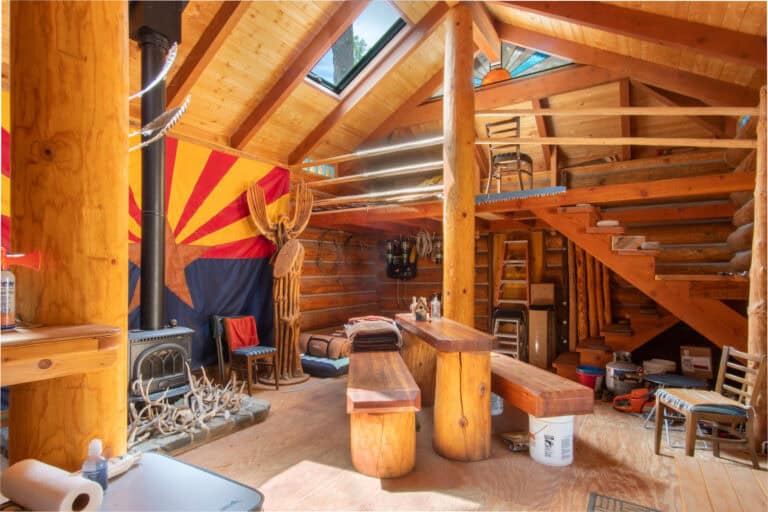
A sleeping loft that works is a genuinely useful room. A sleeping loft that doesn’t is an aspirational photo — it looks functional on paper and barely works in practice. The difference comes down to a handful of design decisions that the plan makes for you before you ever move in.
What Makes a Loft Comfortable for Sleeping
The ceiling height over the sleeping area is the critical number. You need at least 7 feet at the highest accessible point of the loft — not at the ridge, but above the area where you’ll put a mattress and sit up. On a 10:12 roof pitch, this means the mattress can’t be against the side wall. The mattress needs to go where the ceiling is high enough to sit up in bed.
This is the issue that makes many lofts impractical: the plan shows the loft floor area without overlaying the ceiling height contours. You arrive and discover that 40 percent of the loft is under a 4-foot ceiling — usable only for storage, not for anything human-sized. Read the roof pitch carefully before assuming the loft floor area is all usable sleeping area.
Access — Ladder vs. Stair
A ladder is code-compliant for loft access in most residential jurisdictions. A ladder is also genuinely inconvenient for daily sleeping — getting up at 2 AM on a ship’s ladder is not comfortable. Getting into bed carrying a book is not graceful. Children learn to use ladders fine, but adults largely don’t.
If you’re planning to use the loft as your primary or secondary sleeping space for regular use, budget for stairs. The stair adds roughly 30 to 40 square feet and cost, but the quality-of-life difference is significant. Stairs also allow furniture to move — a mattress going up a ship’s ladder is a real problem; going up a stair is manageable.
Railing Design
The open edge of a loft requires a guardrail. IRC minimum is 36 inches for residential; 42 inches feels more secure and prevents a half-asleep person from rolling too close to the edge. Railing design also affects visual connection between the loft and the space below — heavy solid panels block the view; cable or open balusters keep the loft connected to the great room visually.
Ventilation and Temperature
Heat rises. In a vaulted space with a loft, the loft will be significantly warmer than the main floor in summer — sometimes 10 to 15 degrees warmer. Solutions: a ceiling fan in the main vaulted space that circulates air down in summer; an operable gable-end window near the loft that exhausts hot air; or a mini-split if the loft is large enough to justify dedicated HVAC. Without some management strategy, loft sleeping in summer is uncomfortable in most climates.
Who Lofts Work For
Lofts are genuinely good for: children under 12 (who love them), adults using a vacation cabin or weekend house (where occasional inconvenience is acceptable), and very small houses where sleeping capacity without square footage is the goal. They’re less good for primary bedrooms in full-time homes, elderly or mobility-limited occupants, or any situation where getting up at night frequently is expected.
How do you move furniture into a loft?
Plan for this before you build. A mattress is the hardest item — it needs to maneuver through the loft opening. Full/queen mattresses can usually be walked up a steep stair or stood upright through a wide opening. With a ladder, you’re limited to a twin or a compressed mattress that expands after installation. The opening dimensions in the floor matter as much as the stair dimensions.
What’s the minimum floor area for a usable sleeping loft?
50 square feet of usable area at full standing height (7 feet minimum) is the practical minimum for a twin-size sleeping loft. 70 to 80 square feet allows a full bed with room to dress alongside it. Below 50 square feet of clear area, the loft is a sleeping platform but not a functional room.
Can a sleeping loft have a bathroom?
Rarely, without significant design work. A bathroom requires rough plumbing that needs to stack or run to existing drain lines — from a loft, that usually means penetrating the main floor structure and routing through walls. It’s technically possible with a half-bath, but the cost is disproportionate to the benefit in most small-house contexts. A ground-floor bathroom accessible from the loft via stair is the typical and practical solution.
Related Reading
Looking for the plan that fits your land?
Browse the full catalog or call Max Sr. directly. We've been doing this since 1990 — usually it's a 10-minute conversation.